林
园


The Story of an Immigrant Family
Part 1: A Name with Deep Roots
People often ask me why I named my restaurant Lin and Daughters. The answer is deeply personal. The name honors both my father — a retired chef — and my two incredible daughters. My father dedicated his life to our family, and this is my way of honoring that lifelong devotion.
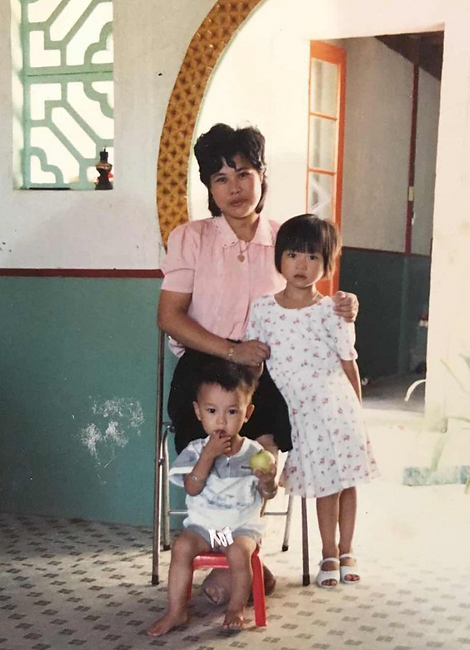
The story begins in rural China. When I was 4-5 years old, my father left home to pursue a better life for us in the United States. I was too young to remember him leaving, but I remember what came after — years of longing. Each month, we would wait by the communal phone in our village, hoping for one of his rare calls. As a child, I didn’t yet have the words to express what it felt like to lose a parent so suddenly, or to understand the deep weight of his absence. My mother was left to raise us alone — including a newborn baby.
What I didn’t realize then was how profoundly that separation would shape the person I would become.
Part 2: Reunion and Rebuilding
Over time, I adjusted to life without my father, but I never let go of the promise he made — that one day, he would come back for us and take us to Mei Guo, “the beautiful country.”
There’s a photo album from those years in China, filled with images of our family — except for one missing face. My middle sister, Lili, isn't in any of them. Like many families living under China’s one-child policy, my parents were forced into impossible decisions.
After I was born, they gave up two daughters in hopes of eventually having a son — a harsh reality in many rural areas.
By some miracle, we were able to reunite with Lili when she was nine. But our youngest sister — whom we never had the chance to meet — remained with her adoptive family. Lin and Daughters is also for her, and for every daughter separated from their family by policies, traditions, or survival.
Part 3: When Baba Came Home
When I was nine, my mother told me we were going to the airport to pick up my father. I was ecstatic. But on the way, I fell asleep. When I woke up, the car felt fuller and the atmosphere more joyful. I asked if we were close to the airport, and everyone laughed: “We’re already on our way home.” I burst into tears, thinking we had missed him — until I heard a voice say gently, “Baba is here.” I looked across the car and saw a man I didn’t recognize — bald, round, with tired eyes. He looked nothing like the father I had imagined in my head, yet somehow, he looked comforting and familiar.
Shortly after his return, Lili rejoined our family. We also located our youngest sister, but her adoptive parents declined to reconnect. Later, we heard through a family friend that she was well-loved and thriving. It was a quiet, bittersweet comfort — a reminder that reunion doesn’t always come in the way we hope.
Part 4: A New Life in a New Land
Three years later, we prepared to leave China. As we drove past green rice fields, my cousin began to cry: “I won’t see you for at least ten years.” In that moment, I understood that I wasn’t just leaving a place — I was saying goodbye to an entire life.
We arrived at JFK the next night. The lights of New York were dazzling, but the city felt cold and sterile. Our new home in Sunset Park was a dark, cramped basement apartment. I cried myself to sleep that first night.
But the next day, my father took us into Manhattan. We shopped for groceries beneath the Manhattan Bridge in Chinatown and returned home to share our first dinner together in America. The food he cooked — rich Cantonese dishes he had once made in restaurants — tasted both new and deeply familiar. That meal was when I first learned he had been a chef.
In that small, dim basement, I realized something: we were poor, I didn’t speak the language, and the path ahead would be difficult. But with my family around that table, sharing good food, I felt full — not just in body, but in heart. For the first time in a long while, I felt whole.
Part 5: Growing Up in a Restaurant
After a year in Brooklyn, my parents took a leap of faith and bought a small takeout restaurant in a quiet Long Island town. None of us spoke English, and only my father had any kitchen experience. There wasn’t much conversation about how we would make it work or how involved I would be. A cousin who spoke English helped out for the first month, but after that, I was running the front of the house for the next five years. It was a huge responsibility, but I never questioned it — the alternative was staying in our rat-infested basement apartment.
For five years, my days were a blur of school, restaurant work, studying, and sleep. Thanksgiving quickly became my favorite holiday — it was the only day we closed the restaurant.
One of my most cherished memories from those years were the quiet nights after closing when my family would gather to make dumplings from scratch. In the chaos of daily life, those moments were a rare chance to simply be together — folding dough, sharing stories, and slowly piecing together the years we had lost. The dumplings became more than food — they were symbols of our love, resilience, and the unity that kept us going.
Part 6: The Full Circle
This restaurant is more than just a place to eat. It’s the culmination of a lifetime of stories — of sacrifice, separation, reunions, resilience, and love. It’s a tribute to my father, who worked tirelessly so I could stand here today. It’s for my daughters, who inspired me to be brave. It’s for my sisters, near and far, and for every daughter who was told she couldn’t or wouldn’t — and did anyway.
Lin and Daughters is our story, told through food. Thank you for being a part of it.